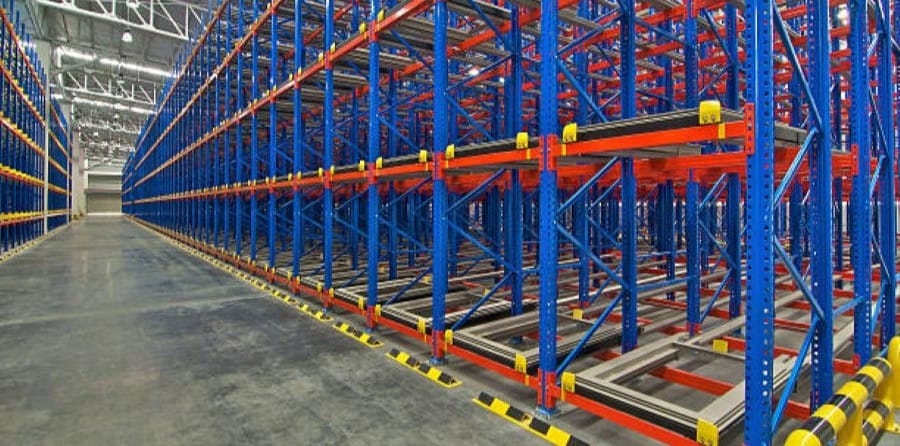
With real estate, logistics, and overhead costs constantly rising over the years, warehouses and distribution centers worldwide are looking for ways to stay profitable. One of the ways to reduce expenses while maintaining operational efficiency is by switching to an automated storage system like pallet shuttle setups.
In this article, we will dive into the intricacies of this system, along with how it works and how it can elevate your warehousing business.
What Is a Pallet Shuttle System?
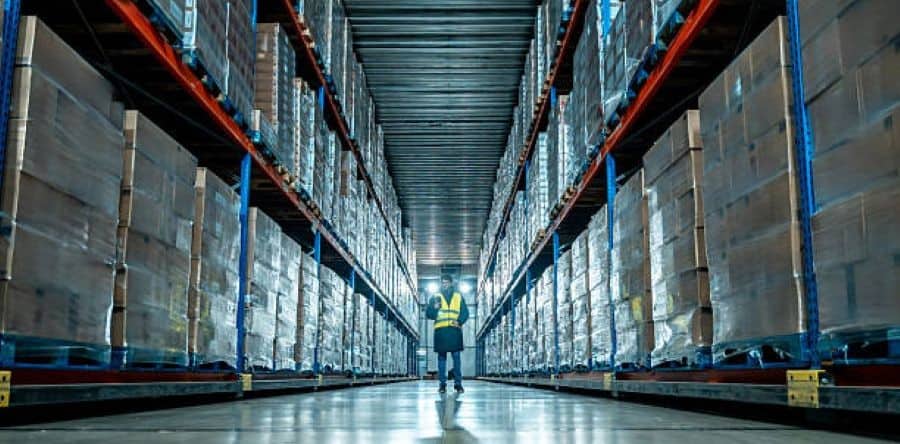
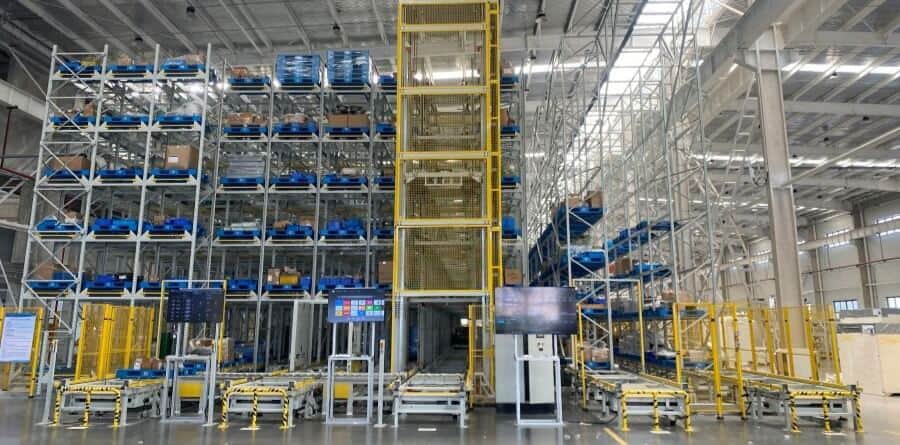
Also called a radio shuttle system, pallet shuttle setups are a long-term and high-density storage solution for automated storage and retrieval of pallets across the warehouse. With this setup, robotic shuttles travel through the tracks to and from the shelving, which then returns to the front for the next task. The system replaces the traditional warehousing setup where forklifts are mainly responsible for storing, retrieving, and transporting goods along the facility.
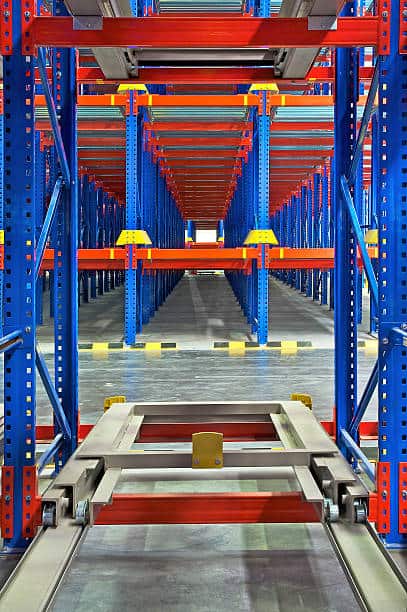
Source: iStock
This system is ideal for warehouses and distribution centers looking to reduce physical labor while keeping operations fast, accurate, and profitable. Pallet shuttles can also operate in narrow aisles, making them perfect for facilities with minimal aisle widths.
How Do Pallet Shuttle Systems Work?
A common question we receive when inquiring about a pallet shuttle racking system is how the setup operates. This section will elaborate on the system’s working principle, as well as the components that make the shuttle system work.
Core Components of Warehouse Shuttle System
A basic pallet shuttle racking system consists of three main components, each playing a key role in the entire operation.
Shuttle
As the self-propelled cart of the system, the shuttle is responsible for moving the pallets along the rails and to their destination. Internal motors raise a platform to lift the pallets off the rack while in transit, while specialized wheels and motors allow the shuttle to move and brake along the tracks. Additionally, these units have fast-charging batteries that power the shuttle and built-in laser distance sensors that detect pallet positioning, depth, and obstacles.
Racking
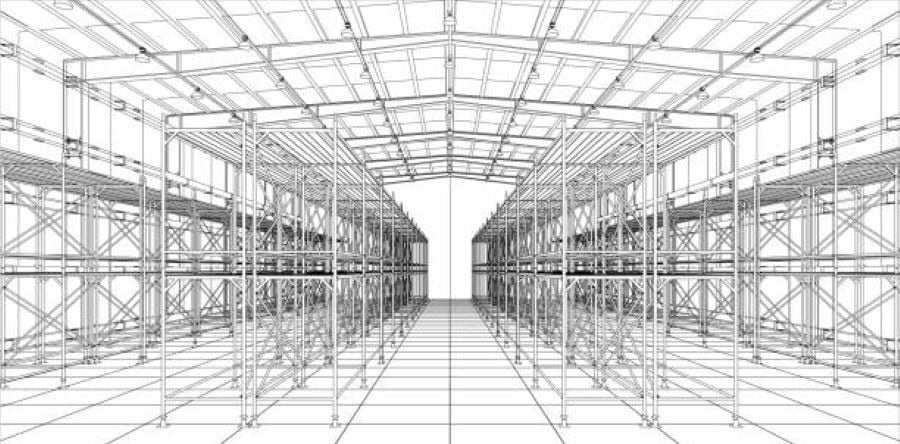
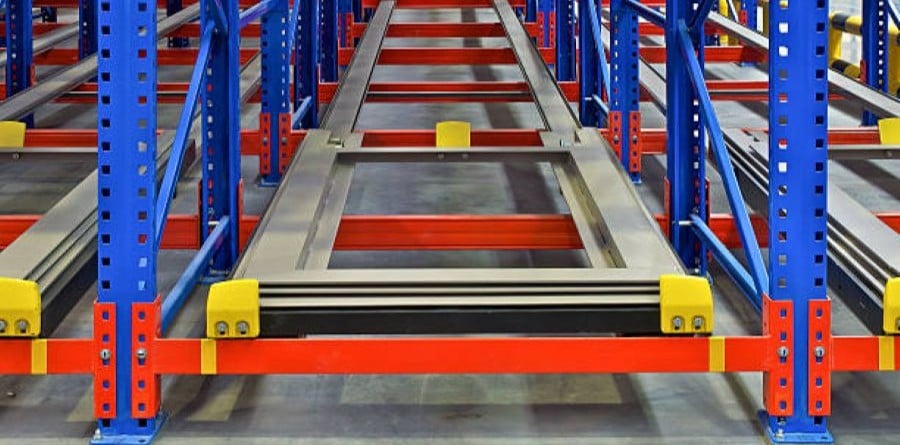
A shuttle pallet racking system uses a customized racking setup specifically engineered for the setup. These typically include galvanized steel frames to support pallet weight and a running track for the shuttle, centering guides to align the shuttle, and mechanical stops at the end of lanes.
Control System
Acting as the brain of the shuttle pallet racking system, the control system manages the entire operation process through a human operator or automated software. Wireless transmitters mounted on shuttles and remote-control tablets provide real-time communication between operators and the machinery, while an onboard PLC on the shuttle processes all travel data.
Working Principle of Shuttle Racking System
The separation of travel and storage is the base working principle of shuttle racking systems, following a coordinated cycle of lifting, traveling, and lowering storage. Forklifts handle the external transport of goods to and from cargo trucks, while the shuttle carts are responsible for moving pallets to the racks within the facility.
The principle follows a four-step process to execute the shuttle racking process, namely:
- Lifting – the shuttle goes underneath the pallet placed on the rack rails. An internal mechanism then lifts the top platform of the shuttle, lifting the pallet off the tracks.
- Horizontal travel – once the pallet is securely lifted, the shuttle moves along the guide rails until it reaches its destination. Built-in sensors help the shuttle navigate the rails and brake either when reaching the end point or when there’s an obstacle.
- Lowering – upon reaching the assigned storage spot, the platform retracts and deposits the pallet on the rack, ensuring it’s snugly placed before moving.
- Return – the shuttle returns to the front aisle, waiting for the next pallet to move.
Key Features: Why Choose Pallet Shuttle Systems
Warehouses implementing a pallet shuttle racking system to store and organize their products see a vast improvement in regular operations. To fully understand its features, we must then know why and how to make the choice of pallet shuttle system and warehouse racking. Some key features that the system offers include the following:
Stockage haute densité
With aisles not required for moving goods around the warehouse anymore, facilities can turn the extra space into additional racks to store products. This expands the storage capacity by up to 80% higher than other shelving options.
Reduce forklift workload
Shuttles replace forklifts in moving the pallets to and from deep racking setups, efficiently reducing travel time between key points of the facility. It also helps minimize potential damage to the goods due to mishandling.
Reduce rack damage
Collisions could usually happen when forklifts navigate through the storage racks and hit them unintentionally, which could lead to long-term damage to the shelves. Since the shuttle racking setup eliminates contact between the forklifts and racks, there’s little to no risk of rack collisions occurring.
Improving safety in cold chain warehouse operations
Certain cold storage warehouses operate in severely low temperatures, which could be dangerous for personnel if exposed to those conditions for long intervals. Implementing a shuttle racking system limits personnel exposure to the cold temperatures, keeping the team safe and healthy.
Supports WMS integration
Shuttle pallet racking systems can utilize smart inventory management systems for automated pallet storage and retrieval. This programmable system helps make warehouse operations more optimized and efficient, leading to better output and increased profits.
Flexible depth configuration
Thanks to more storage space allowed by a pallet shuttle racking system. Single aisle depth can be configured to accommodate more pallets per row. Depending on the racking structure, aisles can reach 30+ pallet positions.
FIFO and LIFO Working
Warehouses operate using one of two inventory strategies: a First-In, First-Out (FIFO) inventory strategy or a Last-In, First-Out (LIFO) strategy. FIFO focuses on managing time-sensitive goods and large volumes of SKUs, thus requiring highly accessible racking systems where pallets can be quickly stored and retrieved. LIFO, on the other hand, prioritizes space utilization and handling bulk storage of identical SKUs; hence, deep-reaching racking systems are preferred.
Depending on operational demands and product requirements, warehouses may need to shift between them from time to time. However, as these strategies require specific pallet racking systems and run on completely different setups, switching from one to the other may be costly for many businesses.
With pallet shuttle racking systems installed, warehouses can easily switch from FIFO to LIFO or vice versa without changing the racking structure. This can be done by simply adjusting the operating direction of the forklift and reconfiguring the WMS commands. Do keep in mind that every channel can only select one mode, meaning mixing FIFO and LIFO in one channel is not an option.
Common Applications of Shuttle Pallet Racking System
No matter the industry, warehouses worldwide face certain challenges in terms of how to efficiently handle pallet storage and retrieval. Let’s see how the shuttle pallet racking system’s automated pallet storing capabilities can address these industry concerns and elevate warehouse operations.
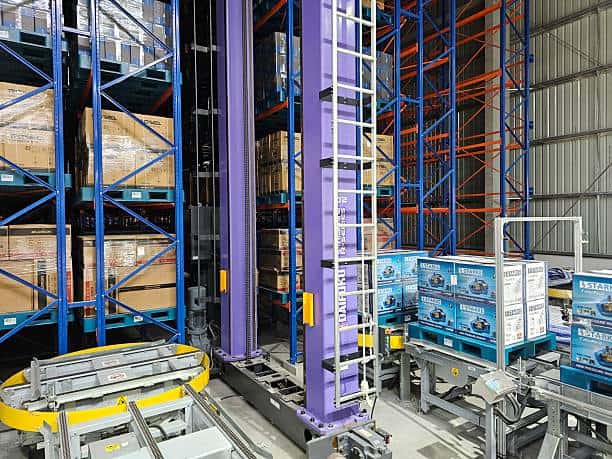
Source: iStock
Cold chain/frozen storage
Cold chain and frozen storage warehouses are some of the most expensive facilities to maintain due to high space and energy costs. In addition, the extremely low temperatures of the warehouse can harm personnel and forklifts when exposed long-term, requiring a solution that could limit human interaction while keeping operation quality.
Utilizing shuttle pallet racking systems in cold storage warehouses can not only reduce energy consumption but can also improve worker safety and working conditions. Shuttles can be configured to operate efficiently at low temperatures, limiting forklift operation at aisle entrances, which keeps warehouse temperatures low and prevents condensation. The setup can also increase storage density by a significant amount, helping maximize valuable real estate.
Dairy products/beverages/alcoholic beverages
Warehouses handling dairy products, beverages, and alcoholic products require a pallet racking system that can quickly store and move goods at short intervals. And as these products have short shelf lives, these facilities must maintain a strict FIFO strategy to prevent expiration of goods. Moreover, storage capacity should be easily and rapidly expandable to accommodate seasonal peak distribution requirements.
The deep-seated channels of shuttle pallet racking systems naturally allow the use of a FIFO strategy, where goods enter one end of the shelving and exit on the other end. This layout ensures product freshness and a great reduction of wasted products due to spoilage.
Moreover, the semi-automatic operation of shuttle pallet racking setups is simple and reliable to use, requiring minimal input for continuous operations. The shelves can also be expanded to accommodate more pallets for peak season inventory.
E-commerce
The e-commerce market is an industry where low to medium turnovers of large, palletized goods are the norm. Warehouses catering to this industry may require intensive storage solutions that could support bulk picking but can’t invest in a fully automated AS/RS setup due to budget or other constraints.
With a shuttle pallet racking setup, e-commerce warehouse racking systems can concentrate slow-moving SKUs into dense storage channels, freeing up space for fast-picking areas. The storage space can also be gradually expanded as business grows, quickly adapting to business demands. Additionally, the semi-automated process of this system can be operated alongside manual forklifts, reducing travel distances within the warehouse and protecting pallet integrity.
Factory Warehouse
Factory warehouses typically act as a temporary storage space between the production line and shipping area. As such, it requires a racking system that can adapt to high-density buffering for incoming or finished materials while supporting JIT replenishment. Quickly shifting between FIFO and LIFO will also help in efficient warehouse operations.
Shuttle pallet racking systems provide factory warehouses with a reliable solution that addresses the industry’s diverse requirements. The compact storage setup of this system helps save workshop space, while reducing forklift congestion in critical chokepoints in the production area. The inventory management strategy can also be changed from FIFO to LIFO with just a few reconfigurations, effortlessly adapting to different processes. The system can also be upgraded to an AGV automatic docking in the future as business needs expand.
Unsuitable scenarios
Despite the advantages that shuttle pallet racking systems offer warehouses, there are situations where the setup is not the optimal option. One such situation is when a warehouse is handling a large variety of SKUs but only a limited number of quantities per type. Since each deep channel can only store a single SKU at a time, small quantities of multiple SKUs will leave most channels empty, leading to low efficiency.
For this situation, it’s best to utilize a high-frequency pallet racking system that allows high selectivity of any SKU. Standard beam racks, mobile racks, or Mini-Load AS/RS racks would better address this demand.
Pallet Shuttle Racking Systems vs. Other Racking Systems
You might be wondering how pallet shuttle racking systems fare against other racking systems available in the market. In this section, we will compare shuttle racking with other setups and see their key advantages, beginning with a matrix guide of each system.
| System type | Storage density | Access flexibility | Automation level | Investment costs | Applicable Scenarios |
| Rayonnage à palettes | Extremely high; passages can reach a depth of 40 meters. | Medium (full-channel FIFO/LIFO strategy, random access requires multiple channels) | Semi-automated (shuttle cars are automated, forklifts operate at the ports). | Medium to high cost (equipment + track, saves manpower and land for long-term operation) | High throughput, homogeneous batch storage, cold storage, food and beverage, and third-party logistics |
| Rayonnage drive-in | High density but limited depth, generally <10 pallets | Low (primarily LIFO strategy, single tray cannot be directly removed) | Manual (forklift enters the aisle) | Low (only shelves, no automated equipment) | Warehouses for single product specifications, small batches, and limited budgets like building materials and chemicals. |
| Pallet Flow Racking | Middle, requires ramp and rear maintenance space | High (natural FIFO strategy, each track is independent) | Manual labor (forklift loading and unloading, pallets sliding by gravity). | Medium (shelves with roller brakes are more expensive than drive-in racks). | FIFO for products with strict shelf-lives, like food, beverages, and FMCG. |
| Mobile Racking | Extremely high (densely packed shelving, with only 1-2 aisles). | It is very tall (it can reach any pallet, just like a regular shelf). | Semi-automatic (the shelves move electrically, but storage and retrieval still rely on forklifts). | High efficiency (motor + guide rail + control system, saving land) | Multiple SKUs, infrequent access but extremely limited space (files, spare parts, medicines) |
| AS/RS | Extremely high (utilizing both vertical and horizontal dimensions, reaching heights of over 30 meters). | High (random access to any tray, precisely scheduled by WMS) | Fully automated (stacker cranes automatically pick and place items, no manual forklifts required). | High cost (stacking cranes, racks, conveyor lines, control systems; large overall investment). | Large-scale distribution centers and production plants with high throughput, many SKUs, and requirements for full automation and unmanned operation |
Pallet Shuttle Racking vs. Drive-in Racking Systems
Key differences between pallet shuttle racking and drive-in racking include:
- Minimal risk of collision – drive-in systems require forklifts to enter the aisles, potentially exposing the steel columns to collisions and damage. Shuttles, on the other hand, are motor-driven and run on rails, eliminating collision risk upon entering aisles.
- Automated vs. manual labor – drive-in systems rely heavily on manual labor for order fulfillment, while shuttle pallet racking mainly uses automated shuttles to complete tasks.
- FIFO/LIFO vs LIFO only – the configuration of drive-in racks limits the pallet movement strategy to LIFO only, unlike pallet shuttle racking, which can utilize both LIFO and FIFO.
Pallet Shuttle Racking vs. Pallet Flow Racking
Some factors that separate pallet flow racking from pallet shuttle racking are the following:
- Space Consumption – the gravity-fed slides of pallet flow racking systems require significant planning for tilt angles and rear maintenance access, eating up valuable warehouse space. Compare this with shuttle pallet racking, which moves pallets through rails that can be connected to the racks, which saves on aisle space.
- FIFO/LIFO vs FIFO only – shuttle pallet racking can be configured to use either a FIFO or LIFO strategy depending on warehouse demands. This is unlike pallet flow racks, as the slides only go a single direction, making it naturally adapt a FIFO strategy.
Pallet Shuttle Racking vs. Mobile Racking
Here are some points on how shuttle pallet racking and mobile racking differ in operation and utility:
- Installation – mobile shelving units have the racks installed on the guide rails and access pallets by moving the shelves using motors. Shuttle pallet racking, on the other hand, has shuttles move into fixed-depth aisles via the tracks.
- Operation speed – operators have to wait for shelves to move before retrieving the pallets, eating up valuable time. In contrast, while shuttles can quickly access aisles, they require multiple aisles to allow random access.
Pallet Shuttle Racking vs. Automated Storage and Retrieval Systems (AS/RS)
AS/RS and pallet shuttle racking have key operational differences, such as:
- Automation level – AS/RS is a completely unmanned operation, using stacker cranes to access any pallet. Shuttle pallet racking, however, is a semi-automated solution that needs forklifts to connect to aisle entrances.
- Investment cost – due to the system’s fully automated and complicated setup, AS/RS has a higher cost to procure, install, and maintain. Whereas shuttle pallet racking systems are semi-automated, thus costing less to source, install, and operate. It can also serve as a transition to going fully automated in the future.
How to Choose Your Trusted Shuttle Racking Supplier
Working with the right shuttle pallet racking supplier is just as important as any factor in managing a warehouse or distribution center. Not only can an expert supplier provide your warehouse with a reliable racking system, but they will also be your partner throughout the sourcing process and beyond. Here are some things you should look for in a supplier for your next shuttle racking system.
In-House Racking Design and Manufacturing Capability
The first thing you should pay close attention to is how well the supplier can make their shuttle pallet racking system. The depth of their design and production capabilities greatly reflects their expertise and understanding of the industry.
Additionally, prioritize working with those who handle the entire production process in-house rather than outsourcing their manufacturing to other facilities. In-house manufacturing ensures that the quality of their racking systems is consistent throughout, adding value to their products.
Compatibility Between Shuttle and Racking
Next, see how well they incorporate the shuttle setup with their racking systems. While these components are typically made separately, it’s crucial that the components fully complement each other for easier installation and stable operation. A seasoned shuttle racking supplier can provide you with several shuttle and racking options that will match your warehouse’s requirements.
Service Capability
Another factor to consider in a potential supplier is the additional services they offer beyond taking your shuttle racking order. Make sure to ask some questions during your initial consultation to better understand what they could offer as a business partner, like:
- Customization service
- Installations and commissioning assistance
- Warranty and after-sales support
The more services the shuttle racking supplier can provide, the more value they can offer your business.
Spare Parts & Expansion Flexibility
Along with checking the supplier’s manufacturing capabilities, you may also want to know how they assist with order fulfillment. Verify if they can supply spare parts for repairs and maintenance to make your sourcing process easier later on.
Moreover, it would greatly help your selection process to ask about expansion options for your shuttle racking as early as possible. Making sure that the shuttle pallet racking system can accommodate future expansion and checking if they can provide the additional equipment will set proper expectations.
Total Cost Advantage
Lastly, weigh the overall cost of sourcing the shuttle pallet racking system with your potential supplier. Procuring a shuttle system is a significant investment, and you want to ensure that you’re getting the best value for your purchase. There’s nothing wrong with asking multiple suppliers for a quote to get the best price in the market.
Also, don’t hesitate to negotiate a price that fits your budget. Manufacturers understand that businesses have a certain amount to work with, and the right supplier will be willing to find a middle ground between the racking system and your budget.
Optimize Your Warehouse with Shuttle Pallet Racking Systems
Shuttle pallet racking systems revolutionize how warehouses handle the storing and retrieval of goods, adding automation to the process for increased speed and efficiency. Shuttle racking also helps reduce overhead costs for warehouse operators while increasing the facility’s storage capacity by up to 80%. The flexibility and versatility of this system also make it usable in various industry applications, from cold storage facilities to e-commerce distribution centers.
Whether you’re sourcing your first setup or upgrading your existing system, let the experts at iWarehousing be your partner in making shuttle pallet racking systems. With your decade-long experience in the industry and in-house manufacturing capabilities, you’re sure to get the right racking system that matches your needs. Contact our team today for your free quote!