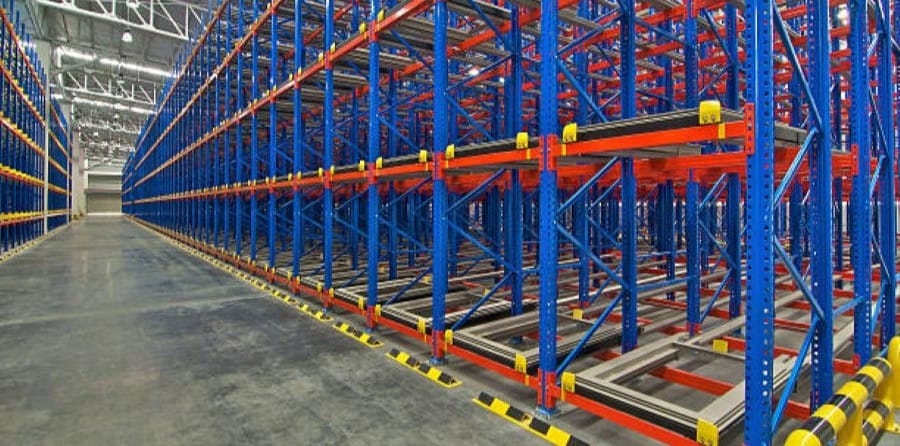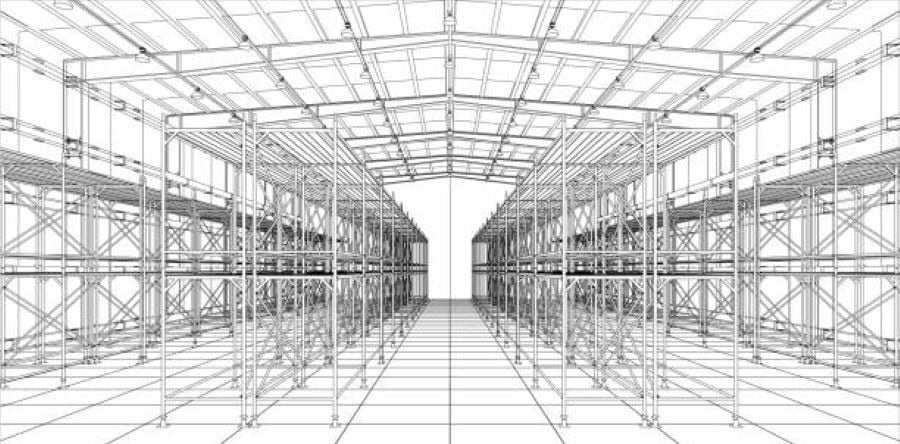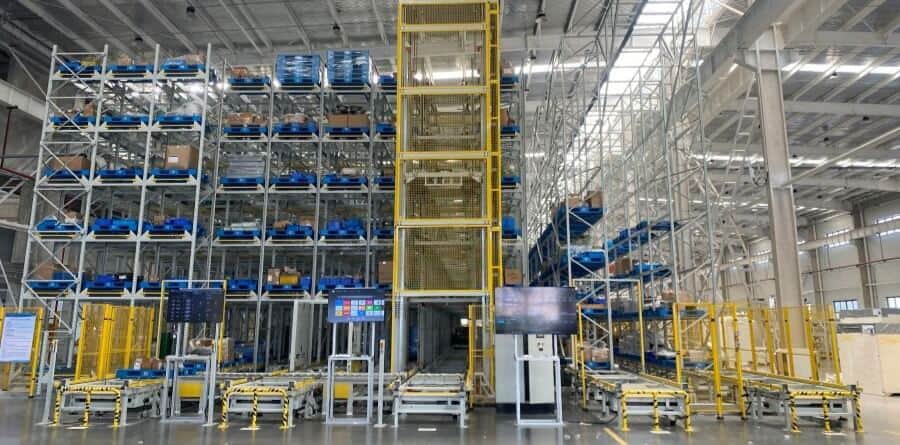
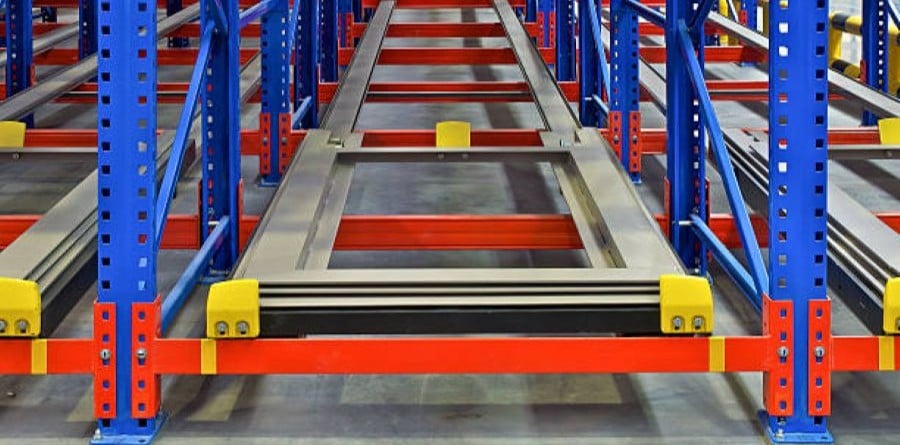
In today’s fast-paced world, where quick and accurate processing is king, shelving is vital to the success of a warehouse’s pallet shuttle automation setup. Having the right racking system determines the overall operational lifespan, safety, and scalability of the system. Additionally, the shelving will be the only fixed asset that will be in use for around 10 to 15 years or more.
In this article, we will enumerate the steps businesses should follow when choosing a pallet shuttle racking setup for shuttle automation. We will also provide some tips to ensure your investment will be fully maximized.
Step 1 – Know Your Operation Before You Specify Racking
The first step of the process, before purchasing a pallet racking setup, is understanding what you’re working with. Depending on the target market, products handled, and location, warehouses have specific requirements, and the shelving should properly meet those needs to optimize the purchase.
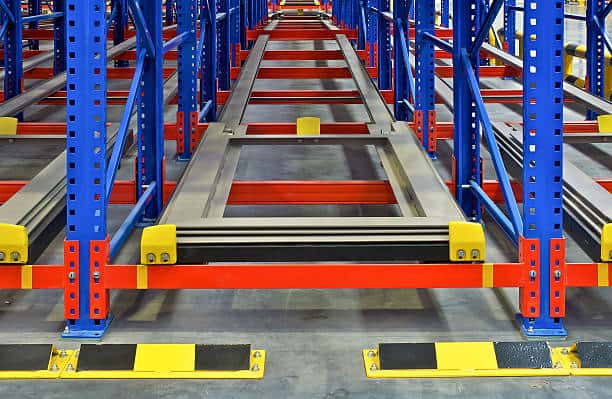
Pallet Profile and Load Data
Ideally, pallet racks must be able to carry several pallets without stressing the beams or jeopardizing the product. Standard pallet sizes and types differ per region, especially between the North American and European markets. North America uses a 48” x 40” GMA pallet for most of its products, while the European standard is 1200 x 800mm.
Other typical pallet sizes used across multiple markets are:
- 48” x 38” for a 55-gallon liquid drum,
- 48” x 45” pallets for automotive parts, and
- 800 x 600 mm or half-pallets for POS locations.
There are also the weight and height of each pallet tray to consider, as the right racks should be designed for the trays to fit snugly on each row. Typical pallet weight is around 2,000 to 2,500 pounds when fully loaded, while average height per pallet is 48 to 60 inches with the contents.
Throughput and Rotation Strategy
The next point of consideration is the process that the warehouse implements throughout its daily operations. Certain pallet racking systems complement a specific operational process, so determining this part will streamline the shelving selection. Factors included in this part include:
- Product volume – the number of inbound or outbound pallet cycles per hour or day will play a role in the type of pallet racking system to purchase. The more frequently the pallets are moved within the warehouse, the shallower the shelving should be for faster product movement. Conversely, if the warehouse stores large volumes of product, then deeper shelving is a better option.
- FIFO or LIFO – for warehouses practicing the First In, First Out (FIFO) method, selective racking will be the best option as it allows better product movement. If the Last In, First Out (LIFO) method is used in the warehouse, then it’s best to opt for deeper racking setups.
- Seasonal Inventory – warehouses that deal with seasonal inventory should consider push-back racking setups, which allow quicker and more efficient movement of product. It also consumes less space than deep racking systems and requires minimal maintenance during off-peak months.
Warehouse Constraints
Another factor warehouse operators should look at is the condition of their warehouse before choosing the pallet racking system. While most pallet racking setup makers allow customization of the pallet racks to ensure a better fit, knowing the location’s limitations will make the process easier.
- Consider the warehouse’s ceiling height, as it will determine the maximum number of rows the racking systems may have.
- The warehouse’s floor area will dictate the shelving layout’s flexibility, including the space between columns and how to utilize irregular areas.
- Ground bearing capacity and flatness of a warehouse will inform the assembly team on installation feasibility, while helping the design team determine if additional support is needed.
Future Automation Roadmap
When setting up an automated shuttle system, operators must also consider whether the shelving is compatible with future upgrades. Including this in the selection process will guarantee that the racks can adapt to any planned changes, like AGV integration or four-way shuttle vehicle modifications. That being said, the shelving design must have expansion interfaces to facilitate the upgrades as it comes.
Step 2 – Understand the Key Racking Parameters for Pallet Shuttle Systems
Now that you have the information about the warehouse, it’s time to know how to integrate the pallet racks into the shuttle system. We’ve enumerated some parameters that would directly affect whether the system can operate normally and within acceptable benchmarks.
Racking Material: Steel Grade and Strength
When used as part of a shuttle racking system, the shelving carries not only the static load of the products but also the dynamic load and vibration during operation. As such, the pallet racks must have the right qualities to handle the task for long periods.
Material-wise, it’s best to opt for pallet racks made from Q355B steel, especially when compared to the cost-effective Q235B steel. The material has a minimum yield strength of 355 MPa, making it capable of supporting heavier pallet loads per lane and better impact resistance even in sub-zero environments. It also has a tensile strength of 450 to 630 MPa for better handling of the shuttle system’s breaking mechanisms.
Additionally, the frames and beams should have the proper thickness to prevent warping and twisting once the weight is introduced. As a rule of thumb, there should be a width-to-thickness ratio of under 30 when using unstiffened parts. Moreover, gaps between the cross-sections must be ample enough to fully support the frame while accounting for minimal sagging due to the load.
Structural Design for Shuttle Compatibility
Shuttle racking systems can be installed in one of two ways, which determines the cost, safety, and tolerances of the entire setup.
Pre-embedded or Integrated rails: connected the upright frames directly, these rails act as both the shuttle’s tracks and the pallet’s support beams.
Pros
- Minimal vertical space requirement allows for extra storage area
- Lower risk of connections loosening over time
- Specific engineering promotes better material efficiency
Cons
- Requires precise installation tracking to prevent misalignment
- More expensive to maintain, repair, and replace
Add-on or Overlay rails: the rail profile is added on top of the pre-installed pallet rack and bolted into the rack’s beams.
Pros
- Easier and faster adjustment before final bolting
- Can be installed on older pallet rack setups without dismantling the existing setup
- Quick replacement capability without compromising the system
Cons
- Requires additional space for installation
- Demands stricter and more frequent inspection and maintenance
Along with selecting the installation type for the shuttle system, you also must consider other factors to ensure smooth operation. These include:
- Proper beam spacing to accommodate the shuttle car
- Enough bending strength of the upright frames to handle the impact force of shuttle cars
- Allocation of clearances to account for tolerances as pallets move along the shuttle
Rail Precision and Smoothness – The Most Overlooked Parameter
Track flatness is the most important operational tolerance in any shuttle racking system, as it determines how smooth the operation will be. Even a simple misalignment outside the baseline can cause catastrophic problems, leading to costly repairs, loss of profit due to downtime, or product damage. The consensus baseline across all industries is an error rate of ≤1.5mm per meter.
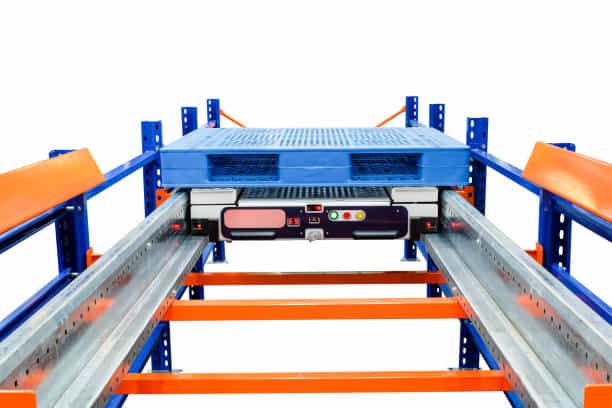
To complement the track’s flatness, the joints must be manufactured and installed with precision accuracy, as they affect the lifespan of the shuttle wheel sets. These joints are where two rail sections meet, and can be processed either through interlocking weaving, laser miter cutting, or field welding and grinding.
The final acceptance criteria for track levelness and verticality are governed by global engineering codes like the FEM 10.2.19. A thorough inspection is required after installation by these bodies to ensure the system works within allowable benchmarks.
For track levelness:
- Longitudinal track slope (along the lane) must not exceed L/500
- Transverse rail parallelism (track gauge width) capped at ± 2.0 mm
- Transverse cross-level (side-to-side height differentials) must not exceed ± 1.5 mm
- Track joint step-off (vertical lip) must be ≤ 0.5 mm.
For racking verticality:
- Total structural plumbness cannot exceed 1/500 of the structure’s total height
Load Capacity Rating
Unlike selective racking systems, automated shuttle racking systems have to consider both the static load and the dynamic load for fluid operation. Whereas static load refers to the weight of the product when stored on shelves, dynamic load has to account for the pallet weight, the cart, and other parts while moving. Properly computing the load capacity and incorporating it in the assembly process will guarantee the setup will work with consistent results.
Labeling load rating is also important in the entire process, as it lets the operators know the machinery and shelving’s capacity before loading a pallet. Labels should include the following information, including:
- Maximum unit load per pallet
- Maximum lane/level load
- Maximum bay capacity
- Limitations on the shuttle cart
- Traceability metadata
As best practice, labels should be made with a bright yellow or orange background with bold black typography. For multi-tier setups, the label must also include a 2d side-profile drawing to show the configuration of beam levels and proper spacing. ISO hazard images must also be included where applicable.
For placement, they should be ideally located in the following areas:
- End-of-aisle frames
- Transition bay entrances
- Permanent mechanical anchoring
Floor Interaction
Since shuttle racking systems are dense and automated, they carry considerable weight even before loading the product on shelves. As such, interaction with the warehouse floor is crucial to guarantee the stability of the entire setup.
Two of the most common methods to anchor the racks to the ground are either using expansion bolts or chemical anchors.
- Expansion bolts are drilled through a hole created to hold the system in place. A metal sleeve expands at the bolt’s base as the nut is tightened, creating a tight clamp that secures the setup to the ground.
- Chemical anchors, on the other hand, use a combination of resin and steel rods to secure the system. After pouring the two-part resin on the hole, the metal rod is inserted, fusing the rod to the concrete floor.
As for the floor flatness, the DIN 18202 provides the maximum deviation limits that the warehouse floor must meet to be considered suitable for installation. Then, the FEM 9.831 details the global elevation envelope of the surface floor slab, along with the floor rotation or tilt.
Step 3 – Decode Racking Tolerances and Industry Standards
While most customers easily overlook this part of the selection process, racking tolerances are a key factor in determining the overall performance of the pallet rack. The manufacturing, installation, and measurement limits of the storage will be based on how the structure can deviate from the original design, not to mention the supplier’s expertise.
The EN 15620 Standard Framework
The EN 15620 is one, if not the most important, document when signing off on the installation of a shuttle racking system. This standard guides operating clearances, manufacturing tolerances, assembly tolerances, and load deformation limits. Shuttle systems fall under Class 400, where the system’s unloaded and loaded clearances are clearly defined.
To meet the requirements as stated in EN 15620, the audit must comply with the following:
- Measuring all physical parts using calibrated optical equipment and/or digital levels
- Concrete floor slab must pass the tolerance deviation standards per DIN 18022
- The handover certificate with exact dimensions, signed by the lead installer, should be handed over
Why is EN 15620 particularly important for shuttle systems?
Compared to the standard pallet racking system that relies on manual forklift operation, shuttle car operations are more complex and technical. As such, the requirements for operating the shuttle system are higher and more demanding. This is where EN 15620 comes in, as it lays out the specifics on foundational safety and operational benchmark warehouses should follow.
Some factors that EN 15620 tackles include:
- Maintaining the sensor alignment of the shuttle
- Guaranteeing how the wheels move along the tracks
- Regulating vertical lifting clearances for every pallet
- Dictating the allowable deflection limits for loaded steel frames
- Ensures legal handover protocol is followed
Key Tolerance Groups for Pallet Shuttle Racking
Shuttle racking systems adhere to different tolerance grades compared to a regular racking system based on the EN 15620. Here’s a table that shows a summary of these differences:
| La mesure | Shuttle Racking | Regular Racking |
| Maximum Beam Sag | L/400 to L/500 | L/200 |
| Track Gauge Parallelism | ± 2.0 mm | Not applicable |
| Vertical Column Leaning | ≤ H/500 to H/750 | ≤ H/500 |
| Vertical Lip | ≤ 0.5 mm | Not applicable |
| Horizontal Clearance | 75 mm to 100 mm+ | 75 mm |
ANSI/RMI Standards (For North American Market)
The North American market follows the American National Standards Institute as a guideline for installing and operating storage racking systems. In particular, ANSI MH16.1 specifies the minimum requirements for the structural design, testing, and utilization of industrial steel storage racks.
For shuttle racking systems, there’s a special significance in verifying the fatigue strength of the racking structure, especially under dynamic loads. Per industry standards, it’s recommended to place labels on the racks that indicate the limits of each shelving setup. These include the maximum permissible load, average unit load, and maximum total load per row.
What to Ask Your Supplier About Standards Compliance
When working with a storage rack supplier for your shuttle racking system, it’s best to come prepared with a checklist to understand better what they offer. Specifically, ask how they can help meet compliance requirements to ensure smooth, reliable operation.
Some questions to ask include:
- Are the shelves made in accordance with EN 15620 Class 400 standards?
- Can you provide third-party testing reports for the shelves?
- Will you provide tolerance acceptance reports once the shelves are installed?
Step 4 – Compare Shuttle Racking with Other High-Density Racking Systems
Next, let us take a deeper dive into how shuttle racking systems are different from other high-density racking systems available. Different racking systems have different size and capacity. Having this information on hand will make choosing the right storage and product management system for your warehouse easier and more practical.

Shuttle Racking vs. Drive-in Racking
Shuttle racking focuses on automatic operation to move product across the facility while supporting a FIFO and LIFO inventory method. Forklifts in this system are typically used to hand over pallets, with aisles going up to 40 meters deep.
Forklifts are the main method of moving pallets across the aisles on drive-in racking systems in a LIFO inventory method. However, due to visibility and exhaust fumes, storage depth can only go up to 10 pallets max.
Recommendation: Shuttle racking is best for warehouses that prioritize efficiency, product security, and progressive scalability. Drive-in racking is ideal for low-budget facilities handling large volumes of a single product type.
Shuttle Racking vs. Pallet Flow Racking
When comparing different types of automated pallet management systems, shuttle racking offers more economy and smoother operation than roller conveyors. However, the components required to run a shuttle racking setup can cost more as well, not to mention the expenses for maintenance and repairs. Additionally, pallet flow racking requires no electricity to function as it runs on pure gravity, while shuttle racking needs battery packs to properly operate.
Recommendation: For high-throughput, cost-effective, and FIFO-focused warehouse racking, pallet flow racking would fit their needs best. But if better space utilization and flexible warehouse racking are needed, then consider shuttle racking.
Shuttle Racking vs. Push-back Racking
Push-back racking setups utilize a combination of mechanical gravity and forklift engine power to move pallets across the aisles. However, it can only go up to nine meters high and up to six pallets deep, highly limiting its total load capacity.
Shuttle racking, on the other hand, uses battery-powered robotic carts to transport pallets along the railing. Not only are the shelves capable of going over 25 meters high, but the shelves can store over 60 pallets deep with a FIFO or FILO setup.
Recommendation: Opt for push-back racking systems when operating a smaller warehouse and working with a limited budget. But if storage depth is the primary requirement, then shuttle racking will be the better option.
When Not to Choose Shuttle Racking
Despite the shuttle racking system’s obvious strengths, there are situations where the setup won’t be the ideal fit. Here are some instances where other warehouse racking systems would work better than shuttle racking:
- A large number of SKUs, yet a low pallet quantity, resulting in empty aisles. A combination of beam racking and forklifts will be a better match for this setup.
- Facilities with low throughput and labor costs could delay the return on investment for installing shuttle racking systems.
- Warehouses with high vertical clearances would benefit more from stacker cranes with an AS/RS setup rather than utilizing a shuttle racking system.
Step 5 – Evaluate Racking Precision During Installation
The installation phase is a great time to ensure the optimal performance of the shuttle racking system, as adjustments can still be made without disrupting warehouse operations. The key is validating the quality of the shelving during the installation and commissioning phases, along with testing the setup.
Pre-installation Site Preparation
Any deviation from the floor flatness can lead to misalignment on the shuttle racking’s track, affecting the system’s overall performance. To prevent this, it’s best to prepare the warehouse’s ground for installation.
Ideally, predict how the concrete mix, slab layout, and subgrade soil will shift over time and configure the concrete placement to address any deviations. Once the concrete floor fully cures, additional inspections must be done and pass data-driven verification methods.
Some requirements for optimal installation include:
- Minimum floor thickness 20cm
- Minimum drilling depth 15cm
- Concrete grade C20/25
Installation Execution Standards
Next is paying close attention to the installation process, making sure the shelving is in line with the acceptable standards. Among the measurements that must be met are:
- Verticality acceptance standard for columns of ±H/500
- Crossbeam levelness control of ±1/16 inch
- Track joint gap control should be uniform with no steps
Additionally, the reference height for track flatness must be measured point by point using a laser level. Record the ground level difference per column location, as well as calculating the shim thickness.
Acceptance Checklist
Before the handover process, conduct a final round of inspection and testing to validate the performance of the shelving and its compatibility with the shuttle racking system.
Inspection covers the following:
- Rail joint gap inspection
- Anchor bolt torque retest
- Precision inspection of horizontality and verticality
- WCS position encoder with accuracy verification
For testing:
- Unloaded test run – the shuttle system should undergo an unloaded test run for five cycles. Each run, speed levels will be switched, and the cart must travel from the starting point to the deepest point, recording the results of each run.
- Full-load test run: conduct a complete storage and retrieval cycle under the recommended load capacity for five cycles, keeping a record of each result.
Optimize Automated Shuttle Systems with the Right Racking Setup
Pallet racking setups are integral to the proper operation of automated shuttle systems, as they act as start and/or end points of the shuttle carts. As such, it’s important to choose a pallet racking solution that would complement the system with minimal reconfigurations.
Warehouse operators should be properly equipped with the information on how to select the racking setup, including the material components, load capacity, and proper tolerance standards. Moreover, knowing the difference between shuttle racking and other warehouse racking options will provide great insight into which system would work best for your facility. Reach out to iWarehouse, your reliable warehouse racking manufacturer, to get your racking solution for next level pallet shuttle automation.