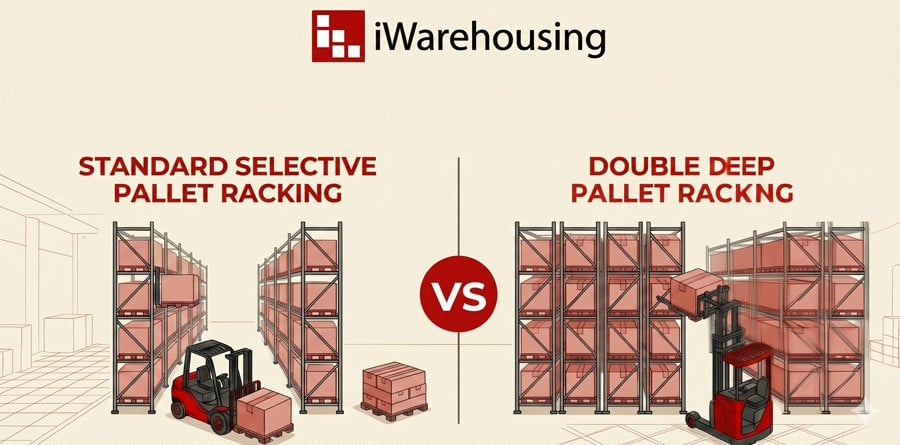
Sourcing a système de rayonnage d'entrepôt to address specific inventory storage demands requires more than just having a budget. You also need to know the strengths of different pallet racking options to see how they can help optimize business operations.
In this article, we’ll focus on two popular inventory management setups, the selective pallet racking system and the double deep pallet racking system. We will identify key features of the specific setup, along with their ideal applications.
Double Deep and Selective Pallet Racking Comparison Table
Let’s begin the discussion by clearly defining the key differences between selective pallet racking systems and double deep racking setups. While there’s no single “best” storage racking system for every scenario, these setups can address diverse storage management requirements according to the situation.
To make the distinctions clearer, we’ve prepared a table detailing key features and what each warehouse racking type offers.
| Feature | Rayonnage à palettes sélectif | Double Deep Racking |
| Storage Density | Lower; pallets are typically arranged in a single row | Higher; allows for 60% more capacity than selective racking with deeper rows |
| Selectivity | 100%, pallets are easily accessible in a single row | 50%, front pallets obscure access to the rear pallets |
| Inventory Flow Method | FIFO (First-In, First-Out) | LIFO (Last-In, First-Out) |
| Compatible Forklift Needed | Standard Counterbalance/Reach forklifts | Specialized forklifts with Deep-Reach / Telescopic features |
| Ideal Applications | High SKU count, high turnover | Bulk storage of identical products |
| Initial Investment | Lower upfront expense, as it uses standard setups and equipment | Higher initial cost; requires specialized forklifts and installation |
Understanding Double Deep Warehouse Racking System
What are Double Deep Warehouse Racking Systems?
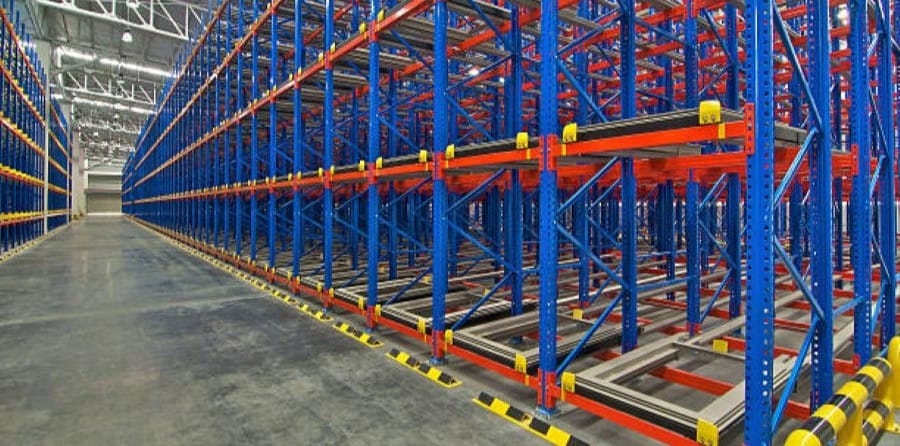
Double deep warehouse racking systems are storage management solutions that provide more pallet storage capabilities in a single setup. Understanding what a double deep pallet racking is simply, it is formed by combining two selective pallet racks together, forming a singular rack with deeper beams to carry more pallets. The setup follows the “Last In, First Out” flow of inventory, where the last item placed would be the first to be removed.
The setup acts as a middle ground between selective pallet racks and high-density warehouse racks, offering the benefits of both while limiting the challenges. It has a deeper storage capacity comparable to the latter, while allowing for quicker access to the pallets like the former.
Pros of Double Deep Warehouse Racking
Increased floor space utilization
With double deep pallet racking systems, warehouses with smaller floor areas can use more of their space to store more product. It is also great for storing multiple pallets of the same SKUs, placing them behind each other.
Higher storage density
The setup also reduces gaps between aisles, ensuring more pallets are safely stored within the beams. These racks can carry up to 65% more pallets compared to the typical selective pallet rack.
Cons of Double Deep Warehouse Racking
Requires specialized forklifts
As the second set of pallets is stored deeper into the rack, not all forklifts can access the product. Warehouses that use this setup would need to secure specialized forklifts with telescopic features, like a deep-reach trunk or those with pantograph attachments.
Lower selectivity
Since double deep pallet racking systems follow the LIFO setup, pallets in front have to be removed to access those at the back. This could cause operational delays or lead to product expiry, especially when storing perishable goods.
Practical Applications
Double deep pallet racks are ideal for the following scenarios:
Storing non-perishable items
Products that have indefinite storage timelines or have minimal monitoring needs can be kept in double deep pallet racks with no worries.
More storage for limited spaces
Smaller warehouses with tight floor areas or in expensive locations can benefit from utilizing double deep pallet racks, as it expands the available storage room by up to 65%.
Smaller SKUs but higher quantity
As the product can be stored up to two pallets deep, it can be used to keep multiple pallets of similar SKUs without interrupting operations.
Understanding Selective Warehouse Pallet Racking
What is Selective Warehouse Pallet Racking?
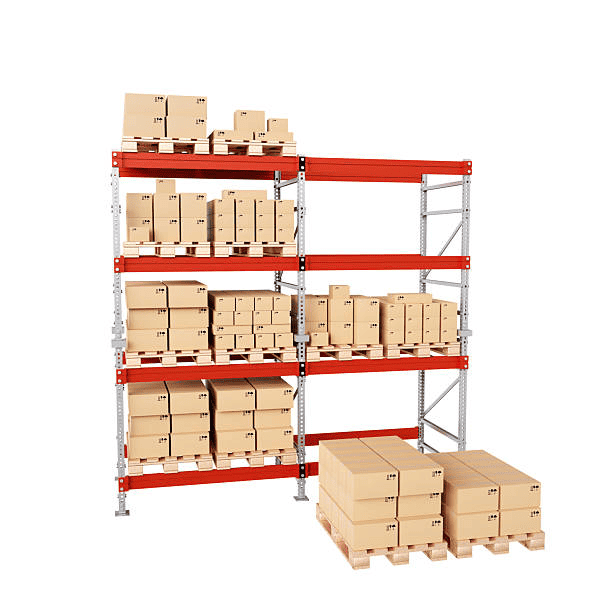
One of the most popular storage management solutions in the market, selective pallet racking systems provide a simple yet effective approach to storing inventory in warehouses. Using a combination of upright frames and beams, it allows for the storage of multiple pallets on rows up to 40 feet high.
Source: iStock
Not only does it give operators quick and uninterrupted access to the pallets, but it also fully complements the “First In, First Out” method of inventory flow. Moreover, it can be integrated into existing storage setups to improve warehousing capabilities with minimal downtime.
Pros of Selective Pallet Racking
Higher selectivity
Forklift operators have full access to the pallets, ensuring 100% selectivity at all times. Selective pallet racks also let warehouses keep large quantities of SKUs, assisting facilities with quick turnovers or handling perishable products.
Lower equipment restrictions
With selective pallet racking systems, warehouses don’t have to source specific equipment to fully utilize the setup. It works well with standard forklifts and can be combined with other, more complex setups to expand operations.
Cons of Selective Pallet Racking
Less storage space
As selective pallet racks only offer a single row of storage space per level, it limits how many pallets they can store at one time. Plus, it requires space between racks for forklifts to move around and pick up the pallets.
Height restrictions
Although selective pallet racks can be assembled at various heights, stacking more than 40 feet could hinder access for standard forklifts.
Practical Applications
Most warehouses opt for selective pallet racking systems for the following reasons:
Perishable inventory
Since selective pallet racks allow for quick access to the pallets, it ensures perishable products can be moved in and out of the facility promptly. This also helps warehouse inspectors monitor expiry dates of products, minimizing wasted money or costly recalls.
Wide SKU variety
This warehouse management system lends itself well to facilities that carry diverse SKUs, as no product is stored behind other pallets. The simple design also lets warehouses store different SKUs beside each other without affecting the quality or monitoring of other SKUs.
Fast turnover facilities
With pallets easily accessible, forklifts can quickly move pallets in and out of the racks with minimal delays. Rows can also be reconfigured for faster order fulfillment, with the top rows used for storing bulk product and the lower sections for manual picking.
How to Choose: Double Deep Pallet Racking or Selective Racking
With the specifics between the two inventory management systems out of the way, it’s time to answer an important question: “Which is better for my warehouse?” Truth is, it actually depends on several factors, including the products the warehouse handles and available space.
When Selective Racking Fits Facility Needs
Selective racking works well for warehouses with high turnovers and quick circulation of products, as it allows operators to move products at a fast pace. It also lets facilities manage multiple SKUs without interruption or the risk of mix-ups.
However, as it only has a single row to place the pallets in per level, it requires extra space for forklifts to move and access the pallets. Thus, it doesn’t work for facilities with tight space requirements.
When Double Deep Racking is the Best Fit for a Facility
Conversely, double deep racking systems are preferred for facilities that handle numerous pallets with the same SKUs, like for bulk packaging or raw material storage. They also fit the needs of warehouses that want to maximize their space but aren’t ready to adopt an automated system yet.
Moreover, they require a certain level of expertise in operating deep-displacement forklifts to fully take advantage of this warehouse management system. Not only does it demand specific equipment to access the pallets in the back row, but it also requires knowledge of how to properly manage inventory without disrupting product flow.
Outfitting Warehouses with the Right Storage Management System
Storage management systems come in different dimensions and styles, each offering specific features aimed at assisting warehouses in storing inventory. Selective pallet racking systems allow facilities to store and manage numerous SKUs, while double deep racking systems are capable of storing more quantities of similar products. Knowing which setup to choose relies on your warehouse’s conditions, including product types carried and available space.
Your search for a reliable warehouse storage management manufacturer ends with iWarehousing. We’re experts in designing and manufacturing custom inventory storage solutions specifically made according to your warehousing needs. Contact us today to grab your free quote!