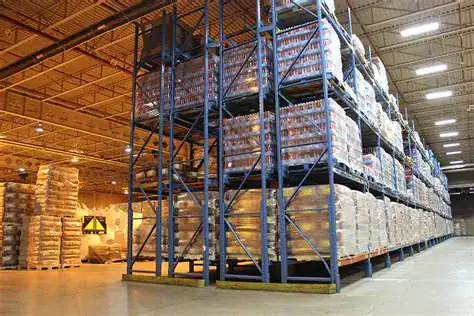
Double deep pallet racking solutions address the need for more storage depth in warehouses and storage facilities. This setup complements locations that manage large volumes of products with minimal variety, as it essentially doubles the storage space.
At iWarehousing, we place your need for efficient and reliable warehouse racking systems. We lead the market in designing, manufacturing, and assembling double deep pallet racks that go through strict quality inspections for long-term stability. The straightforward design and setup of our double deep pallet racking system allow warehouses to maximize their floor space and simplify inventory management.
Stores two pallets deep per lane, increasing capacity compared to selective racks, maximizing limited warehouse space while maintaining forklift access.
It combines depth storage with a front-loading design, so there are no complex LIFO restrictions like with drive-in systems.
Operates with standard narrow-aisle reach trucks or deep-reach forklifts, reducing fleet costs.
Boltless connectors and teardrop slots allow for quick beam adjustments for SKU changes.
Q235B steel frames and reinforced base plates prevent deflection at double-load stress points.
Saves space compared to selective racks and has a lower setup cost than drive-in systems.
Maximize space and accessibility for medium-turnover goods without compromising operational speed.
| Beam Length (mm) | Frame Heights (mm) | Frame Depth (mm) |
|---|---|---|
| 1372 | 2438 | 838 |
| 2591 | 3048 | 914 |
| 2743 | 3658 | 1067 |
| 3048 | 4267 | 1219 |
Choosing the right double deep pallet racking system requires careful consideration of your warehouse layout, storage requirements, and operational needs. Compared with standard selective pallet racking, double deep pallet racking provides higher storage density by allowing pallets to be stored two rows deep, reducing aisle requirements while increasing warehouse capacity.
The main advantage of double deep pallet racking is its ability to increase storage capacity by reducing the number of aisles needed. It is an ideal choice for warehouses where maximizing floor space utilization is a priority.
Before selecting a system, evaluate your warehouse dimensions, ceiling height, available floor area, and required storage positions. Double deep racking works particularly well in warehouses with sufficient depth and a need for higher pallet storage density.
For facilities with large quantities of similar products or lower picking frequency, double deep pallet racking can provide a more efficient storage layout compared with traditional selective pallet racking.
Every double deep pallet racking system should be designed according to the specific pallet dimensions and load requirements.
Consider factors such as pallet width, depth, height, unit load weight, and storage levels. Heavy-duty applications may require reinforced upright frames, stronger beams, and customized load capacities to ensure long-term safety and stability.
A properly designed racking system helps prevent overloading issues and ensures reliable performance in demanding warehouse environments.
Double deep pallet racking requires forklifts with extended reach capability because pallets are stored behind each other. The type of forklift used in your warehouse will directly affect the rack layout and operating efficiency.
Before installation, consider forklift reach distance, lifting height, aisle width, and operator working conditions. Proper coordination between the racking system and material handling equipment helps maintain safe and smooth warehouse operations.
Double deep pallet racking is most suitable for warehouses that store multiple pallets of the same SKU or products with similar turnover patterns.
Because the second pallet position is accessed through the front pallet position, it may not be the best choice for operations requiring immediate access to every pallet. However, for bulk storage, seasonal inventory, and distribution centers with large quantities of similar goods, double deep racking offers an excellent balance between storage density and accessibility.
A professional racking manufacturer can help design a double deep pallet racking system that matches your warehouse requirements.
Beyond rack production, factors such as engineering support, load calculations, customization capability, quality control, and installation guidance are important when selecting a supplier.
At iWarehouse, we provide customized double deep pallet racking solutions designed for different warehouse environments. Our systems are manufactured with reliable components and can be configured according to pallet specifications, storage capacity requirements, and operational needs.
Diversify your business by offering custom double deep pallet racking systems specifically designed for your target market. iWarehousing caters to customization requests through an assortment of options, including design and style modification, adjusting the rack’s dimensions, and load capacity customization, among others. You can even opt for a specific surface coating to help identify products better.
The entire production process is done in-house, ensuring we can maintain the utmost quality in every step.
Our custom storage solutions are not only affordable but also come with a flexible payment plan.
We test our storage racks according to US ANSI MH16.1-2012(R2019) and EU BS EN 15512:2020+A102022 benchmarks.
All incoming metal batches include a material report indicating their quality and thickness.
Routine quality inspections and meticulous testing guarantee optimal performance and superior durability.
Samples for custom configurations can be produced as fast as three days upon request.
Double deep pallet racking is a high-density storage system designed to store two pallets per bay—one positioned directly behind the other. This configuration effectively doubles the storage depth of standard selective racking within the same footprint.
It offers a fundamental trade-off: Selective racking provides direct, immediate access to every single pallet, maximizing accessibility. In contrast, double deep racking prioritizes space efficiency, significantly reducing aisle space to store more pallets, at the cost of immediate access to the rear pallet.

Its primary benefit is enhanced storage density. By reducing the number of aisles, it increases warehouse cube utilization and is ideal for storing a high volume of fewer SKUs. This makes operations more space-efficient.
Typically, no. Its design is better suited for slow to medium-turnover inventory where immediate, selective access to every pallet is not constantly required. It prioritizes space savings over access speed.
It is not ideal for strict First-In-First-Out (FIFO) inventory management. Because the rear pallet is blocked by the front one, it naturally follows a Last-In-First-Out (LIFO) flow. For FIFO, consider pallet flow racking.
Yes, it is highly customizable. The beam lengths and upright frame configurations can be engineered to accommodate specific pallet dimensions and weight capacities, ensuring optimal fit and safety for your inventory.
Double deep racking sits between standard selective racking (highest accessibility) and even denser systems like drive-in or push-back racking. It offers a practical balance of improved density over selective racking while still using relatively standard reach trucks, making it a popular middle-ground choice.
Yes, proper equipment is critical. Operating a double deep system requires reach trucks with extended-reach forks capable of safely accessing and retrieving the second pallet. This is a key operational consideration and cost factor.
Yes, retrofitting is possible but requires careful assessment. Key factors include: ensuring sufficient space and ceiling height for the new layout, verifying floor condition and strength, and confirming forklift compatibility (both the trucks and operator skill). A professional site audit is strongly recommended.
Follow this checklist:
Inventory Profile: Do you have a high volume of fewer SKUs mit slow-to-medium turnover (LIFO acceptable)?
Equipment & Cost: Are you prepared to use or acquire specialized reach trucks?
Space Goal: Is your primary objective to maximize storage density within a fixed area?
Operations: Can your workflow accommodate the slight access delay for retrieving rear pallets?
If you answer “yes” to most points, double deep racking warrants serious consideration. Consulting with a storage system specialist is the final, crucial step.