Choosing the right pallet racking and shelving system is one of the most important decisions in warehouse planning. Whether you need heavy-duty warehouse shelving or a specialised high-density solution, the type of industrial shelving and storage you select determines how much you can store, how fast you can pick, and what forklifts you need. This guide covers the 9 most common types of warehouse pallet shelving systems used in modern warehouses. Start with a comparison table to quickly see the differences, then dive into each system with a clear description, advantages, disadvantages, and best use cases. We finish with a practical framework for choosing the right commercial racking and shelving for your operation.
Types of Racking System in Warehouse – Comparison Table
| Pallet Racking Type | Key Design Features | Best For |
| Selective Pallet Racking | Individual pallet positions, standard aisles, 100% direct access | High SKU count, fast turnover, common forklifts |
| Very Narrow Aisle Racking System | Same frame as selective, floor rails, aisles ≤ 1.8m | Cold storage, expensive land, turret trucks |
| Double Deep Pallet Racking System | Shuttle carrier inside the lane, semi-automated | More pallets per SKU, reduce aisles |
| Two pallets deep, needs a reach truck, LIFO | Forklift enters the bay, rack acts as guide rails | High volume, low variety, LIFO |
| Push Back Pallet Racking | Rails and carts, push pallets backward, LIFO | Multiple pallets per SKU, avoid product crush |
| Pallet Flow Rack | Gravity rollers with slope, FIFO dynamic flow | Cold chain, expiry sensitive, high turnover |
| Shuttle Pallet Racking System | Shuttle carrier inside the lane, semi automated | Cold storage, high density, batch out |
| Mobile Racking System | Motorized bases move on rails, one aisle only | Very expensive rent, picking focused |
| Cantilever Racking System | Arms extend from columns, no front posts | Long or irregular items like pipes, timber |
Selective Pallet Racking
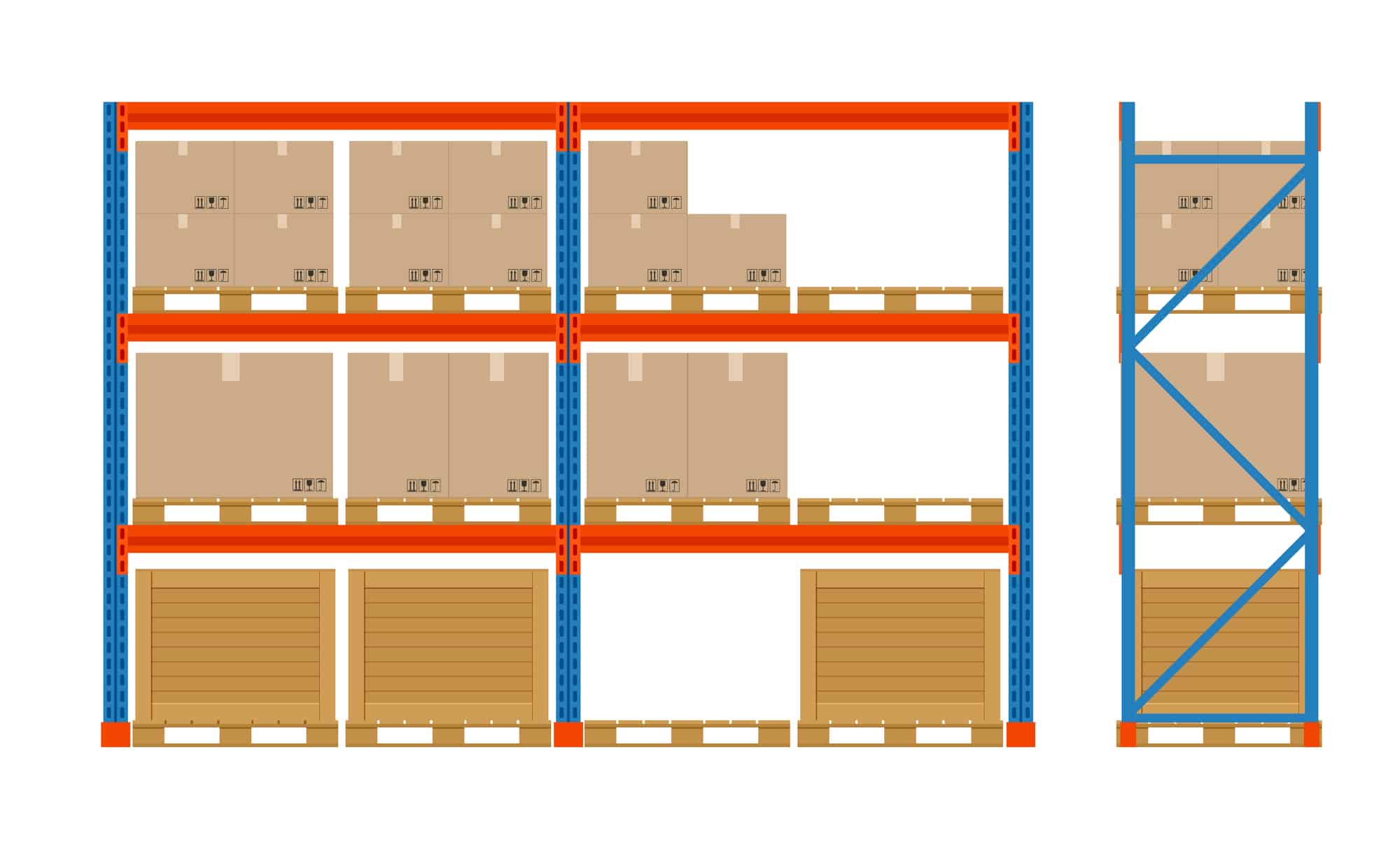
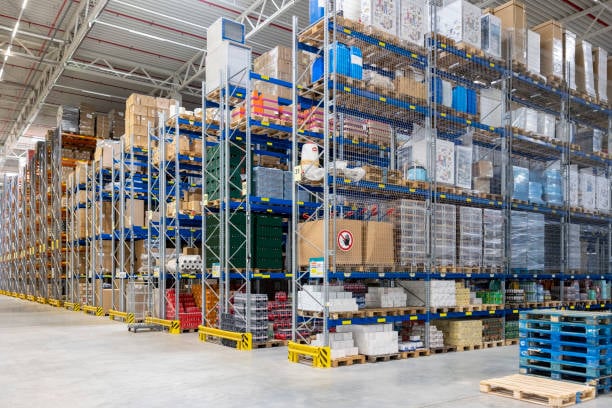
Selective pallet racking is the most common form of warehouse pallet shelving and serves as the benchmark for all other industrial racking and shelving types. Each pallet has its own dedicated position and is 100 percent accessible, with aisles usually over three metres wide to accommodate standard counterbalance forklifts. Every high-density design, from drive-in pallet racking to shuttle systems, is a variation that reduces aisles or increases depth starting from this basic frame.
Advantages
- 100% direct access provides the highest picking efficiency.
- No SKU limitations, any palletised good works.
- No special forklift training or equipment required.
- Low initial investment with simple installation and maintenance.
Disadvantages
- Most floor space is lost to aisles.
- Lowest storage density of any shelving in the warehouse.
Best Applications
This system is ideal for warehouses with many SKUs, low inventory per SKU, and high turnover. Typical users include e-commerce returns centres, third-party logistics hubs, and regional distribution centres. If land cost is low and flexibility is critical, this is the safest choice among commercial racking and shelving options.
Very Narrow Aisle Racking System
The rack structure of a very narrow aisle racking system is identical to selective pallet racking, but the difference is on the floor, where rails are installed in the aisles, and forklifts follow these guides. This allows aisle width to be reduced to 1.8 metres or less, but the forklifts must be turret trucks or purpose-built VNA trucks with rotating forks. Technically, this is not a new rack type but rather a high-density application of selective racking, and in the industry, it is known as VNA pallet racking.
Advantages
- Retains 100% direct access.
- Density approaches that of drive-in pallet racking.
- High picking accuracy, especially valuable in cold storage.
Disadvantages
- Turret trucks are expensive.
- Floor flatness tolerance is extremely strict.
- No passing in aisles, so multiple truck efficiency drops.
Best Applications
Cold storage warehouses are the largest users of very narrow aisle racking systems. It is also suitable when land is expensive, and you need both density and direct access. Many facilities are now built from the start with VNA pallet racking specifications.
Double Deep Pallet Racking System
A double deep pallet racking system places two selective racks back to back so that pallets are stored two positions deep. To reach the back pallet, the front pallet must first be removed, which requires a reach truck with telescopic forks. This design is a direct derivative of selective racking, where you trade some accessibility for fewer aisles.
Advantages
- Reduces aisle count by about 30% compared to selective racking.
- Lower cost than fully automated systems.
- Works well for medium volume SKUs with two to four pallets each.
Disadvantages
- Strictly LIFO, not suitable for expiry-sensitive goods.
- Special forklift costs more than standard.
- Picking efficiency is lower than that of single deep.
Best Applications
Double deep pallet racking is the right choice when each SKU has several pallets but drive in pallet racking is too aggressive. Typical applications include beverage wholesale, appliance storage, and bulk spare parts. It is often specified as a double deep pallet racking system in warehouse layout plans.
Drive-In Pallet Racking
Drive in pallet racking has no horizontal beams because the rack itself becomes the forklift guide. The forklift drives inside the lane and places pallets on steel rails, and retrieval requires driving in again so flow is strictly LIFO. This is a pure density system where direct access is sacrificed and one lane holds only one SKU. This category includes both drive in and drive through racking, with drive-through allowing access from both ends for FIFO operation.
Advantages
- Very high space utilisation.
- Low investment for the density achieved.
- Ideal for large batches of a few items.
Disadvantages
- LIFO only, not suitable for fresh goods.
- The forklift must operate inside the structure, creating collision risk.
- One lane holds one SKU, poor flexibility.
Best Applications
Drive in pallet racking is used for products with few SKUs, large inbound shipments, and full batch outbound. Common examples are plastic resin, bottled water, and paper rolls. It is often the first choice when budget limits the use of a shuttle pallet racking system.
Push Back Pallet Racking
Push back pallet racking uses rails and nested carts in depth so that when a second pallet is loaded, it pushes the first pallet backward. When the front pallet is removed, the next pallet rolls forward. This creates a LIFO high-density system that is safer than drive-in pallet racking because the forklift stays in the aisle. Understanding push-back racking disadvantages is important before choosing this design.
Advantages
- The forklift never enters the lane, resulting in less damage.
- Higher density than a double deep pallet racking system.
- Works well for two to six pallets per SKU.
Disadvantages
- LIFO flow, not for expiry control.
- More moving parts and higher maintenance than static systems.
- Depth is usually limited to six pallets.
Best Applications
Push back pallet racking is common for frozen food, industrial materials, and non-perishable goods. It is also used when the warehouse wants high density but refuses the safety risks of drive-in and drive-through racking. Always evaluate push back racking’s disadvantages against your inventory turnover.
Pallet Flow Rack
Pallet flow rack, also called gravity flow rack, has inclined rollers in the lane so that pallets are loaded at the rear and flow to the front by gravity. It is the only high-density system that delivers true FIFO automatically, with each lane holding one SKU. This is a common choice for industrial shelving and storage in food and pharmaceutical warehouses.
Advantages
- True FIFO, perfect for expiry management.
- High density with fewer aisles.
- Concentrated picking face improves picker efficiency.
Disadvantages
- Higher initial cost than drive-in or push back.
- Rollers require regular cleaning and maintenance.
- Pallet quality matters, because poor pallets get stuck.
Best Applications
Cold chain is the largest user of pallet flow rack, followed by dairy, beverage, and pharmaceutical, where FIFO is mandatory. It is frequently installed as part of a larger industrial shelving and storage system.
Shuttle Pallet Racking System
A shuttle pallet racking system uses a battery powered carrier that runs inside the lane. The forklift places the shuttle and the pallet on the rail, and the shuttle automatically moves the pallet to the deep position. This is a semi-automated high-density system and essentially an electrical upgrade of drive in pallet racking. Both FIFO and LIFO operations are possible.
Advantages
- Forklift stays outside, meaning zero lane damage.
- Supports both FIFO and LIFO.
- In cold storage, it saves energy because forklift running time inside is reduced.
Disadvantages
- Shuttles need charging and battery management.
- Higher investment than drive in and push back.
- Lane depth may be limited by shuttle battery life.
Best Applications
Cold storage is the primary market for shuttle pallet racking systems, along with factories that have high-density needs and batch storage. Typical installations are dairy cold rooms and frozen food distribution. The system is increasingly replacing drive in pallet racking in new cold store projects.
Mobile Racking System
A mobile racking system, also called mobile shelving, has motorised bases under each rack section so that the racks move on rails embedded in the floor. Only one aisle is opened at a time, and after picking the aisle is closed and another is opened. This design trades access time for floor space, delivering very high density while 100 percent direct access is maintained. It is a premium choice for storage warehouse shelving where land is scarce.
Advantages
- Density is close to drive-in but every pallet is directly accessible.
- Closed racks offer dust and theft protection.
- Great way to expand capacity without building an extension.
Disadvantages
- Access is slow because you must wait for racks to move.
- The electrical system requires regular maintenance.
- Not suitable for high-frequency picking.
Best Applications
Mobile racking systems are used for archives, spare parts storage, and tool rooms, as well as warehouses in city centres with extremely high rent. It suits any low frequency access application with high-value goods. It is often specified as storage warehouse shelving for documents and small parts.
Cantilever Racking Systems
A cantilever racking system has no front columns because arms extend from single sided or double sided columns and long items rest on these arms. It is the specialist for long load storage and can be either stationary or mobile. When used for hand loaded items, it is sometimes called a cantilever shelving system.
Advantages
- Solves the long item storage problem.
- Easy access with common forklifts.
- Arm lengths and heights can be customised.
Disadvantages
- Density is lower than pallet racking.
- Not suitable for small items or loose parts.
Best Applications
Cantilever warehouse racking is used for aluminium profiles, steel tubes, lumber, and plastic pipes. Any product longer than two metres that cannot be palletised requires this solution. It is also used in retail back of store as a cantilever shelving system for carpet and timber displays.
How to Choose the Right Warehouse Pallet Shelving System
The best commercial racking and shelving layout balances density, efficiency, and total cost.
Cargo shape
Standard pallets work with most systems.
Long items, pipes, and timber require a cantilever racking system.
Access frequency
If every pallet is accessed daily, use selective or VNA pallet racking.
If access is occasional, high-density systems like drive in or mobile racking become viable.
Batch size
Low volume per SKU favours a selective or double deep pallet racking system.
High volume per SKU points to drive in, push back, or shuttle pallet racking system.
FIFO requirement
If stock rotation is critical, choose pallet flow rack or a shuttle in FIFO mode.
If LIFO is acceptable, drive in and push-back pallet racking are more economical.
Land cost and budget
Expensive land justifies VNA, mobile, or shuttle systems.
Low land cost favours selective racking with standard forklifts.
Conclusion
No single system is perfect. The best warehouse pallet shelving matches your SKU profile, pallet depth, turnover rate, and land cost. The right choice saves hundreds of thousands of dollars every year.
Still not sure which industrial pallet racking is right for you? Get expert advice tailored to your warehouse. Visit iWarehousing for a free consultation and a custom layout design. Our team specialises in all types of warehouse pallet shelving systems – from simple selective to fully automated shuttle solutions. Let us help you turn your storage space into a profit centre.